When choosing a cooling or climate control system for your home, office, commercial building, or industrial facility, you may often hear the terms HVAC and AC. Although people sometimes use these terms interchangeably, they do not mean exactly the same thing.
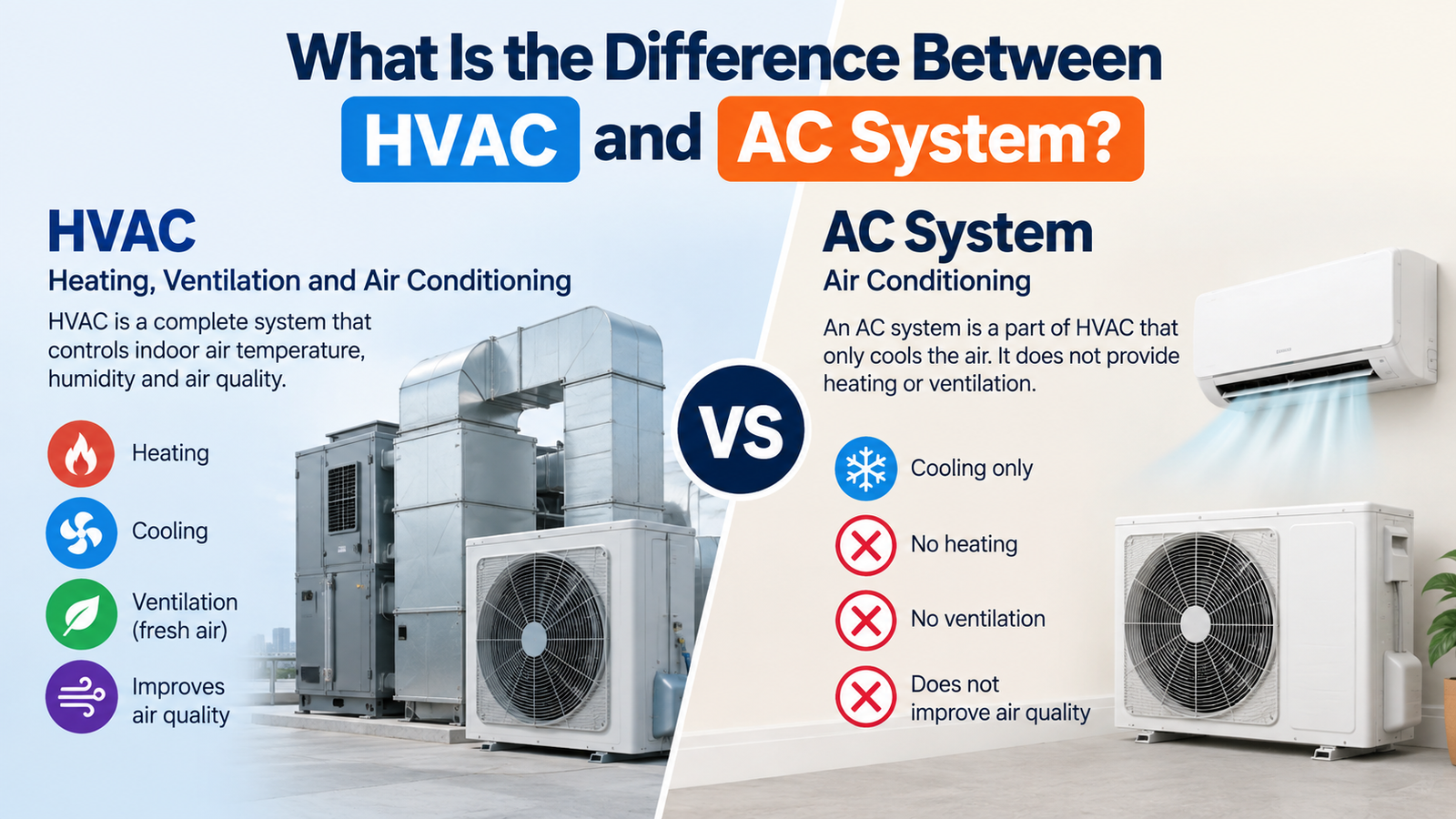
The main difference between HVAC and AC is that AC refers specifically to air conditioning and cooling, while HVAC refers to a complete system that can provide heating, ventilation, and air conditioning.
Understanding the difference between HVAC and AC systems can help you choose the right solution for your property, improve indoor comfort, reduce energy consumption, and plan maintenance more effectively.
What Is an AC System?
AC stands for air conditioning. An AC system is primarily designed to cool indoor spaces by removing heat and humidity from the air.
Air conditioning is commonly used in homes, offices, shops, warehouses, restaurants, hotels, and industrial facilities throughout the UAE, where high outdoor temperatures make effective cooling essential.
A typical AC system works by circulating refrigerant between indoor and outdoor components. Heat is absorbed from inside the building and transferred outside, allowing cooler air to circulate throughout the indoor space.
Common types of AC systems include:
- Split air conditioners
- Window air conditioners
- Central air conditioning systems
- Ducted air conditioning systems
- Packaged air conditioning units
- Cassette air conditioners
- Variable refrigerant flow systems
The main purpose of an AC system is therefore cooling and humidity control.
What Is an HVAC System?
HVAC stands for heating, ventilation, and air conditioning.
An HVAC system provides broader indoor climate control compared with a standard AC system. Depending on the design, it can regulate temperature, control humidity, circulate fresh air, filter indoor air, and provide both heating and cooling.
HVAC systems are commonly installed in:
- Commercial buildings
- Offices
- Shopping centres
- Hotels
- Hospitals
- Factories
- Warehouses
- Residential buildings
- Schools
- Industrial facilities
A complete HVAC system may include air conditioners, heaters, ventilation ducts, air handling units, filters, thermostats, fans, and other components.
Therefore, air conditioning is usually considered one part of a larger HVAC system.
HVAC vs AC: What Is the Main Difference?
The simplest way to understand the difference is this:
AC controls cooling, while HVAC can control heating, ventilation, cooling, air circulation, and indoor air quality.
An air conditioner may form part of an HVAC system, but an HVAC system includes additional components and functions beyond cooling.
For example, a commercial building may use an HVAC system containing air conditioning units, ventilation ducts, air handling units, filters, exhaust fans, and temperature control equipment.
Difference in Function
The biggest difference between HVAC and AC systems is their function.
An AC system mainly reduces indoor temperature and humidity.
An HVAC system can manage several aspects of indoor climate, including:
- Heating
- Cooling
- Ventilation
- Air circulation
- Humidity control
- Air filtration
- Indoor air quality
This makes HVAC systems more comprehensive for large buildings and commercial applications.
How Does an AC System Work?
An air conditioning system generally uses a refrigeration cycle to transfer heat from indoors to outdoors.
The main components usually include:
Compressor
The compressor circulates refrigerant through the air conditioning system and increases its pressure.
Condenser
The condenser releases heat absorbed from inside the building into the outdoor environment.
Evaporator Coil
The evaporator coil absorbs heat from indoor air, allowing cooler air to be circulated back into the room.
Expansion Valve
The expansion valve regulates the flow and pressure of refrigerant entering the evaporator.
Blower Fan
The blower distributes cooled air throughout the indoor area.
Together, these components continuously remove heat from indoor spaces.
How Does an HVAC System Work?
An HVAC system combines several processes to maintain comfortable indoor conditions.
The cooling component works similarly to an air conditioning system. However, HVAC systems may also include ventilation and heating equipment.
The ventilation system circulates air throughout the building and can remove stale air while introducing fresh air.
Depending on the building and system design, an HVAC installation may include:
- Air handling units
- Fan coil units
- Ductwork
- Chillers
- Cooling towers
- Exhaust systems
- Filters
- Thermostats
- Heating equipment
- Fresh air systems
These components work together to regulate temperature and maintain suitable indoor air conditions.
Is HVAC the Same as Central Air Conditioning?
Not exactly.
Central air conditioning is primarily a cooling system that distributes conditioned air throughout a building using ducts.
HVAC is a broader term that can include central air conditioning along with heating and ventilation equipment.
For example, a building may have central AC as one component of its complete HVAC system.
Therefore:
Central AC is a type of cooling solution, while HVAC describes the complete climate control system.
Which Is Better, HVAC or AC?
Neither system is automatically better. The right choice depends on the requirements of your building.
An individual AC unit may be sufficient for a bedroom, apartment, small office, or retail shop.
A complete HVAC system may be more suitable for:
- Large offices
- Commercial buildings
- Hotels
- Hospitals
- Warehouses
- Factories
- Shopping centres
- Industrial facilities
Large facilities usually require greater control over ventilation, cooling, air distribution, humidity, and indoor air quality.
HVAC and AC Systems in the UAE
Cooling systems are particularly important in the UAE because of the country’s high temperatures for much of the year.
Residential and commercial properties in Dubai, Sharjah, Abu Dhabi, Ajman, and other emirates rely heavily on air conditioning and HVAC systems to maintain comfortable indoor conditions.
Because these systems operate for extended periods, regular HVAC maintenance in UAE and AC maintenance services are important for maintaining efficiency and preventing unexpected breakdowns.
A poorly maintained system can experience reduced cooling performance, increased energy consumption, airflow problems, unusual noise, and mechanical failure.
Importance of Regular HVAC and AC Maintenance
Whether you operate a standalone AC unit or a complete HVAC system, regular maintenance can help extend equipment life and improve performance.
Professional maintenance may include:
- Cleaning air filters
- Checking refrigerant levels
- Inspecting electrical components
- Cleaning evaporator and condenser coils
- Checking air ducts
- Inspecting motors and fans
- Testing thermostats
- Checking drainage systems
- Measuring airflow
- Identifying damaged components
Routine HVAC repair and maintenance services in UAE can identify problems before they develop into expensive failures.
Common Signs Your HVAC or AC System Needs Repair
You should consider arranging professional inspection if you notice any of the following problems.
Weak Airflow
Poor airflow may indicate blocked filters, damaged fans, duct problems, or other system faults.
AC Not Cooling Properly
If your air conditioner is running but the room remains warm, there may be a refrigerant problem, dirty coil, compressor fault, or airflow restriction.
Unusual Noise
Grinding, rattling, buzzing, or clicking sounds can indicate loose or damaged mechanical components.
Water Leakage
Blocked drainage lines or problems with the evaporator system can sometimes cause water leakage around air conditioning equipment.
High Electricity Bills
An inefficient AC or HVAC system may consume significantly more electricity than necessary.
Regular servicing can help restore efficient operation.
HVAC Repair vs AC Repair
Another important distinction is the scope of repair work.
AC repair services normally focus on cooling related equipment such as compressors, condensers, evaporators, refrigerant systems, fans, and electrical components.
HVAC repair services may cover a much broader system, including ventilation equipment, ducting, air handling units, chillers, cooling equipment, heating equipment, thermostats, and airflow systems.
For commercial and industrial properties, choosing an experienced HVAC maintenance company in UAE can help ensure that the complete system is inspected rather than only the cooling unit.
How to Choose an HVAC and AC Maintenance Company in UAE
When choosing a company for HVAC or AC services, consider several important factors.
Look for a service provider with experienced technicians, professional diagnostic equipment, knowledge of different HVAC systems, access to suitable replacement components, and the ability to provide preventive maintenance as well as emergency repairs.
You should also confirm that the company has experience working with the type of system installed at your property.
Commercial and industrial HVAC systems can be considerably more complex than residential air conditioners, so appropriate technical expertise is important.
Frequently Asked Questions About HVAC and AC Systems
Is AC Part of HVAC?
Yes. Air conditioning is generally considered the cooling component of an HVAC system.
Does HVAC Include Air Conditioning?
Yes. HVAC stands for heating, ventilation, and air conditioning.
Can You Have AC Without HVAC?
Yes. A standalone split AC or window AC can provide cooling without forming part of a complete building HVAC system.
Does HVAC Always Include Heating?
The term HVAC includes heating, but the actual equipment installed depends on the building, local climate, and system design.
Which System Is Better for UAE Properties?
For smaller rooms and residential applications, standalone or split AC systems may be sufficient. Larger commercial and industrial buildings usually benefit from integrated HVAC systems because they provide better control over cooling, ventilation, airflow, and indoor air quality.
Conclusion
The main difference between HVAC and AC systems is their overall function.
An AC system primarily provides cooling, while an HVAC system can provide heating, ventilation, air conditioning, humidity management, and air circulation.
For residential properties, a conventional air conditioning system may provide everything needed for comfortable indoor temperatures. Commercial and industrial facilities often require complete HVAC solutions because their cooling, ventilation, and airflow requirements are more complex.
Regular servicing is important for both systems. Professional AC repair, HVAC repair, HVAC maintenance, and air conditioning maintenance services in UAE can improve efficiency, reduce breakdowns, and extend equipment life.
Idris Ali Electrical provides professional HVAC repair and maintenance services in Dubai, Sharjah, Abu Dhabi, and across the UAE. Our experienced team can inspect, maintain, troubleshoot, and repair HVAC and air conditioning systems for commercial and industrial applications.