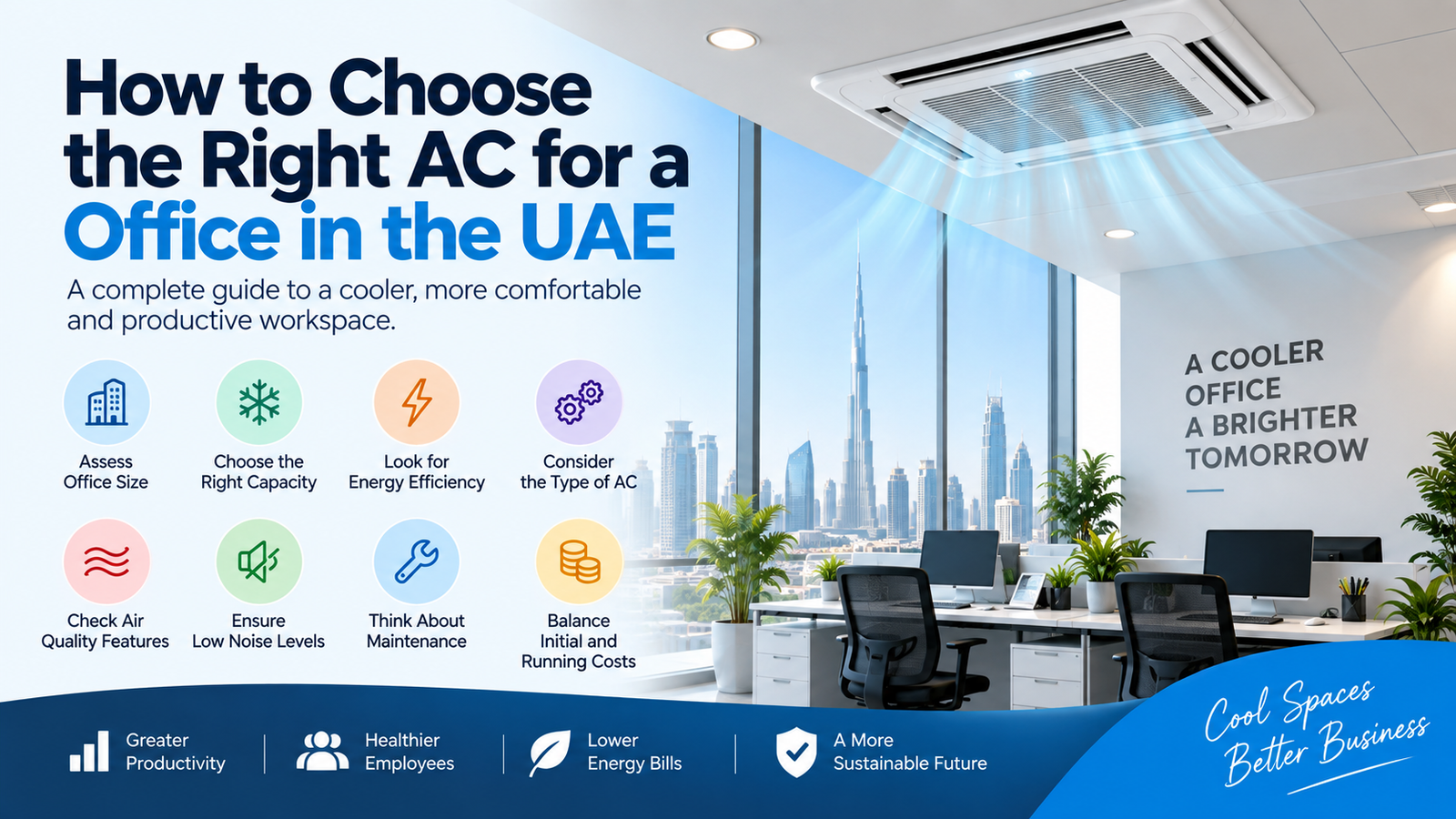
Choosing the right air conditioning system for an office in the UAE is not simply a matter of selecting the biggest AC unit available. Office cooling requirements depend on several factors, including floor area, number of employees, sunlight exposure, building insulation, equipment heat load, working hours, and ventilation requirements.
Because temperatures in the UAE remain high for much of the year, an efficient office AC system is essential for employee comfort, productivity, equipment protection, and energy efficiency.
The right system should provide consistent cooling without excessive electricity consumption or frequent maintenance problems.
This guide explains how to choose the right AC for an office in the UAE and which factors businesses should consider before installing or replacing an air conditioning system.
Why Choosing the Right Office AC Is Important
An air conditioning system that is too small may struggle to maintain the required indoor temperature. It may operate continuously, increase electricity consumption, and experience premature component wear.
An oversized AC system can also create problems. It may cool the room too quickly without adequately controlling humidity, while frequent switching can increase wear on compressors and other components.
Correct AC selection can help businesses achieve:
- Comfortable indoor temperatures
- Better energy efficiency
- Improved indoor air quality
- Lower electricity costs
- Reduced maintenance requirements
- Longer equipment life
- Consistent cooling throughout the office
For offices in Dubai, Abu Dhabi, Sharjah, and other areas of the UAE, professional AC sizing and installation are particularly important because systems often operate for extended periods.
1. Calculate the Cooling Capacity Required
One of the most important factors when choosing an office AC is cooling capacity.
Air conditioning capacity is commonly measured in BTU per hour or tons of refrigeration.
The required capacity depends on much more than floor area alone.
A proper cooling load calculation should consider:
- Office size
- Ceiling height
- Number of employees
- Number of computers and electrical devices
- Amount of sunlight entering the office
- Window size and orientation
- Building insulation
- Number of doors
- Lighting
- Ventilation requirements
- Hours of operation
For example, an office containing multiple computers, printers, lighting systems, and several employees may require greater cooling capacity than an empty room of the same size.
A professional AC installation company in UAE should assess the complete heat load before recommending equipment.
2. Consider the Size and Layout of Your Office
Office layout strongly influences AC system selection.
A small single room office may only require one split AC system.
A larger office with meeting rooms, cabins, reception areas, and open workspaces may require several units or a centralised cooling solution.
Consider whether the office contains:
- Open plan work areas
- Individual offices
- Conference rooms
- Server rooms
- Reception areas
- Storage spaces
- Kitchens or pantry areas
Different areas may have different cooling requirements.
For example, a meeting room may require increased cooling when fully occupied, while a server room may require continuous temperature control even when the rest of the office is closed.
3. Choose the Right Type of AC System
Several types of air conditioning systems can be used in UAE offices.
Split AC Systems
Split air conditioners are commonly used in smaller offices.
They normally consist of an indoor unit and an outdoor unit.
Advantages include:
- Relatively simple installation
- Independent temperature control
- Good cooling efficiency
- Suitable for individual rooms
- Lower initial cost compared with larger central systems
Split systems can be a practical choice for small businesses and individual office rooms.
Cassette AC Systems
Cassette air conditioners are installed in suspended ceilings and distribute conditioned air from several directions.
They are frequently used in offices, retail spaces, restaurants, and commercial buildings.
Their advantages include:
- Even air distribution
- Space saving installation
- Professional appearance
- Suitable for medium sized office areas
Cassette systems can be particularly useful for open office environments.
Ducted AC Systems
Ducted air conditioning distributes cooled air through ducts connected to different rooms or zones.
This type of system can provide a cleaner appearance because most components are concealed above the ceiling.
Ducted systems may be suitable for larger offices requiring consistent cooling across several rooms.
VRF and VRV Systems
Variable refrigerant flow systems are commonly used in larger commercial buildings.
These systems allow multiple indoor units to connect to one outdoor system and can provide independent temperature control for different zones.
They can be suitable for:
- Large offices
- Multi room commercial spaces
- Corporate buildings
- Offices requiring separate temperature zones
When properly designed, these systems can provide efficient and flexible climate control.
Central Air Conditioning
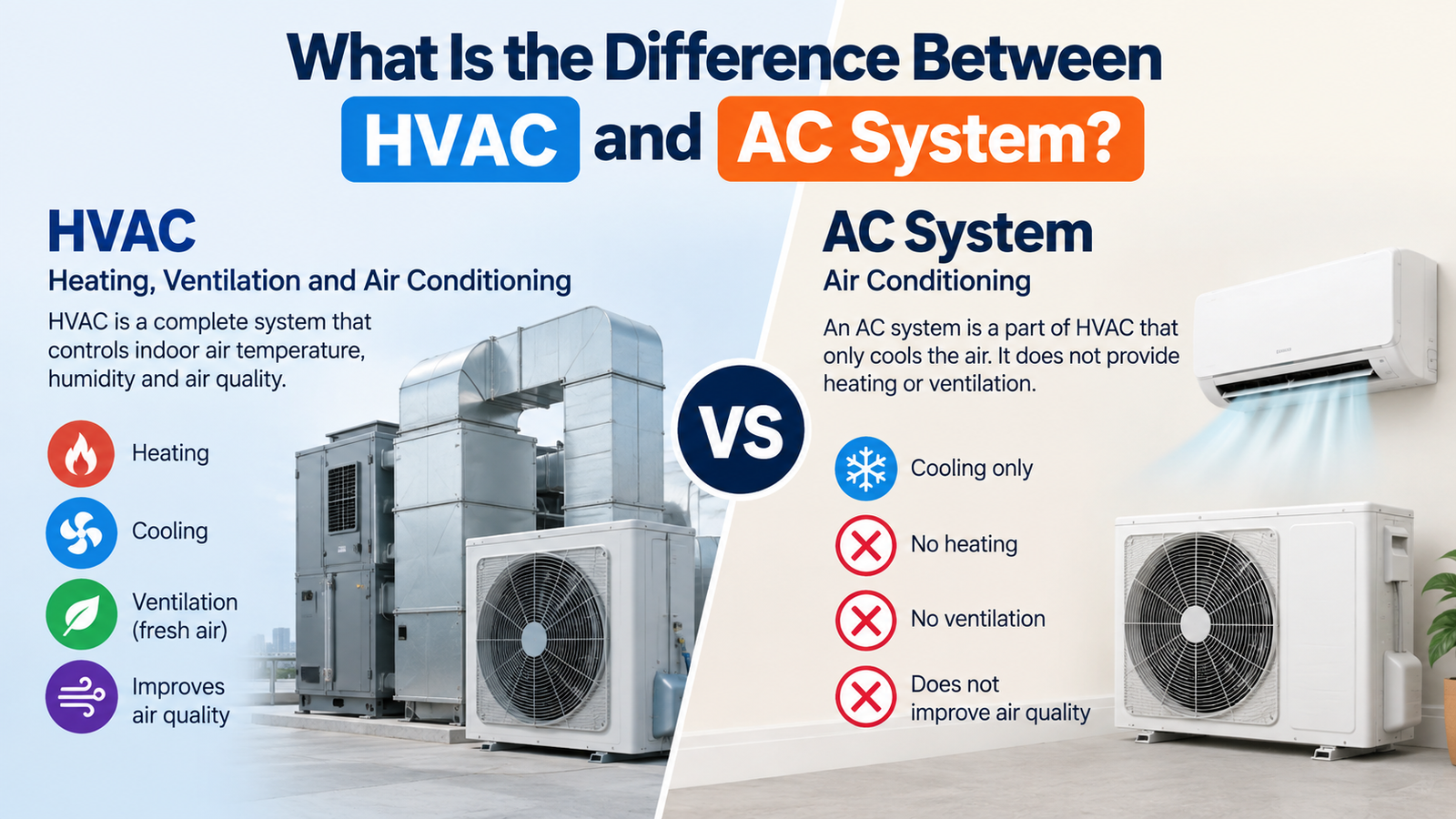
Large office buildings may use central cooling systems connected to air handling equipment, ducts, chillers, or other HVAC components.
These systems require professional design, installation, and ongoing HVAC maintenance services in UAE.
4. Consider Energy Efficiency
Energy efficiency should be one of the main considerations when selecting office air conditioning.
An inefficient AC system can significantly increase operating costs, particularly when it runs for many hours every day.
When comparing units, consider:
- Energy efficiency ratings
- Compressor technology
- Inverter operation
- Thermostat controls
- Zoning capability
- Variable speed fans
- Automatic scheduling
Inverter AC systems can adjust compressor output according to cooling demand rather than constantly operating at full capacity.
This can improve temperature stability and reduce unnecessary electricity consumption.
For larger offices, zoning can also improve efficiency by allowing businesses to cool occupied areas without wasting energy on unused rooms.
5. Check Whether the AC Can Handle UAE Climate Conditions
The UAE climate places significant demand on air conditioning systems.
Outdoor temperatures can become extremely high, particularly during summer.
An office AC system should therefore be capable of maintaining effective cooling during demanding operating conditions.
Important considerations include:
- Outdoor temperature capability
- Compressor quality
- Condenser performance
- Refrigerant system design
- Outdoor unit ventilation
- Dust resistance
- Maintenance accessibility
Outdoor condenser units should also be installed where they can release heat effectively.
Restricted airflow around the outdoor unit can reduce cooling performance and increase compressor workload.
6. Consider Office Occupancy
People generate heat, so the number of employees working in the office directly affects cooling requirements.
An office designed for five employees will normally require less cooling than the same space occupied by twenty people.
Meeting rooms require particular attention because occupancy can change significantly throughout the day.
An experienced HVAC contractor should consider maximum expected occupancy when performing a cooling load calculation.
7. Account for Computers and Electrical Equipment
Modern offices contain significant electrical equipment, including:
- Desktop computers
- Laptops
- Monitors
- Printers
- Servers
- Networking equipment
- Photocopiers
- Lighting systems
Electrical equipment produces heat.
Offices containing servers or large numbers of computers may therefore require additional cooling capacity.
Server rooms frequently need dedicated cooling because equipment can continue generating heat outside standard office hours.
8. Consider Ventilation and Indoor Air Quality
Cooling alone is not enough for many office environments.
Ventilation is also important because occupied offices require appropriate fresh air circulation.
Poor ventilation can contribute to:
- Stale indoor air
- Unpleasant odours
- Excess humidity
- Poor employee comfort
- Increased concentrations of indoor pollutants
A complete HVAC system in UAE may combine air conditioning with ventilation, filtration, and fresh air systems.
Businesses should therefore consider both temperature control and indoor air quality when planning office cooling.
9. Consider Noise Levels
Noise can become an important issue in offices.
An AC unit that generates excessive noise can disturb employees, meetings, telephone conversations, and customer interactions.
Before selecting an AC system, check the operating noise levels of both indoor and outdoor equipment.
For executive offices, conference rooms, and customer facing environments, quieter air conditioning systems are generally preferable.
10. Think About Maintenance Requirements
Every AC system requires regular maintenance.
Before purchasing equipment, consider:
- Filter accessibility
- Spare parts availability
- Ease of servicing
- Coil cleaning requirements
- Drainage access
- Manufacturer support
Regular AC maintenance in UAE can help prevent common problems such as reduced airflow, poor cooling, water leakage, unusual noise, and compressor failure.
Preventive maintenance is especially important for offices because unexpected AC failure can disrupt normal business operations.
11. Consider Smart Temperature Controls
Modern office AC systems can be connected to programmable thermostats and smart control systems.
These controls can allow businesses to:
- Schedule operating times
- Set different temperatures for different zones
- Reduce cooling outside working hours
- Monitor temperature remotely
- Improve energy efficiency
For larger offices, building management systems can provide centralised control over air conditioning and other building services.
12. Compare Initial Cost With Long Term Operating Cost
The cheapest AC system is not always the most economical choice.
When comparing systems, businesses should consider the total cost of ownership.
This includes:
- Purchase price
- Installation cost
- Electricity consumption
- Maintenance cost
- Replacement parts
- Expected equipment lifespan
A more efficient system may cost more initially but provide significant savings through reduced energy consumption and improved reliability.
How to Choose an AC Installation Company in UAE
Professional installation is as important as selecting the correct AC system.
Poor installation can cause problems such as:
- Insufficient cooling
- Refrigerant leaks
- Water leakage
- Poor airflow
- Excessive energy consumption
- Compressor damage
When selecting an AC installation and maintenance company in UAE, look for experienced technicians who can assess cooling requirements, recommend suitable equipment, install systems correctly, and provide ongoing maintenance support.
Frequently Asked Questions
What size AC is best for an office?
The correct AC size depends on office area, ceiling height, number of occupants, windows, insulation, equipment, lighting, and other heat sources. A professional cooling load calculation should be performed before choosing a unit.
Is split AC suitable for an office?
Yes. Split AC systems can be suitable for small offices and individual rooms. Larger offices may require cassette, ducted, VRF, or central HVAC systems.
Which AC system is best for a large office?
Large offices often benefit from ducted, VRF, VRV, or central HVAC systems because they allow better control across multiple rooms and zones.
How often should office AC systems be maintained?
Maintenance frequency depends on system type, operating hours, environment, and manufacturer requirements. Offices with air conditioning operating for long periods should arrange routine inspections and preventive maintenance.
Can an oversized AC increase electricity consumption?
Yes. Incorrectly sized equipment can operate inefficiently. Oversized systems may frequently switch on and off, while undersized systems may run continuously.
Conclusion
Choosing the right AC for an office in the UAE requires careful consideration of cooling capacity, office size, occupancy, equipment heat load, ventilation, energy efficiency, noise, and maintenance requirements.
Small offices may be adequately served by split or cassette air conditioning systems, while larger commercial spaces may benefit from ducted, VRF, VRV, or central HVAC solutions.
The most important step is to avoid selecting an AC system based on room size or price alone. A professional cooling load assessment helps ensure that the system provides sufficient cooling while operating efficiently.
Idris Ali Electrical provides professional AC repair, AC maintenance, HVAC repair, HVAC maintenance, and commercial cooling services in Dubai, Sharjah, Abu Dhabi, and across the UAE. Our experienced team can inspect existing systems, diagnose cooling problems, perform maintenance, and help businesses maintain reliable office cooling throughout the year.